
SealHut · The everyday bag guide
Best handheld vacuum sealers in Australia
Choose a pump and bags that work together, then check whether the cleaning routine suits you.
A handheld vacuum sealer can be useful for small packing jobs and compatible bags you want to reopen. The important purchase is the whole system: pump, valve, zipper, replacement supplies and care instructions.
A researched comparison based on manufacturer documentation and supplied listing descriptions. We have not performed hands-on testing of these kits.
Start with the connection
GIRAFFYCO is our first kit to investigate
Start with a named system whose pump and replacement bags are documented. The GIRAFFYCO set gives this shortlist that starting point. The generic 60kPa electric handheld kit is another listing to inspect after its exact identity and compatibility are confirmed.
This is not a claim that one pump is the most powerful or the cheapest today. A clear bag system is simply easier to evaluate than a broad product title with unspecified accessories.
If you want to make packs from open-ended rolls, compare an external heat-sealing machine instead. If you want to use a sealer away from a socket, our portable vacuum sealer guide covers the power and travel questions.
A good handheld purchase answers
Which bags fit?
Identify the valve system and replacement sizes.
How is it charged?
Confirm the input, cable and any required adaptor.
How is it cleaned?
Check the pump, valve, bag and drying instructions separately.
Three quick answers before the shortlist
Which handheld vacuum sealer should I compare first in Australia?
Start with the GIRAFFYCO set if you want a named handheld valve-bag system with manufacturer documentation. Compare its current Australian offer with the supplied 60kPa handheld kit only after confirming that kit’s exact identity, compatible bags, charging arrangement and support.
Can a handheld vacuum sealer use any zipper bag?
No. A typical handheld vacuum pump needs a compatible valve on a bag or container. An ordinary zipper bag without the right valve does not automatically work with the pump. Match the exact pump and bag system.
Does a handheld sealer remove the need to refrigerate food?
No. Vacuum packing does not sterilise food or replace refrigeration. Keep perishable food refrigerated at 5°C or colder and follow its storage instructions. Do not extend a use-by date simply because air has been removed.
What the pump actually does
A handheld vacuum pump removes air through a valve
The bag’s opening must already be closed in the way its instructions require. The pump connects to the compatible valve, then removes air. The zipper and valve are therefore part of the sealing system, not just accessories around the machine.
This is different from a heat-sealing machine that closes an open bag with a seam. Product names can blur that distinction, so look for the actual operating method before choosing supplies.
A small pump may be convenient on a crowded bench because it can be put away quickly. That convenience depends on the bags being easy to find, suitable for the portions you pack, and straightforward to care for after use.
Do not treat an impressive suction figure as a substitute for these checks. Removing air and keeping the bag sealed are related jobs, but a product title does not establish long-term seal retention or how a particular valve behaves after repeated use.
Two options, clearly labelled
The handheld shortlist
Compare the actual delivered kit and its replacement supplies. The named option has manufacturer sources; the generic listing needs more confirmation before purchase. Current Australian prices were not verified, so there is no fixed price ranking.
GIRAFFYCO compact handheld set
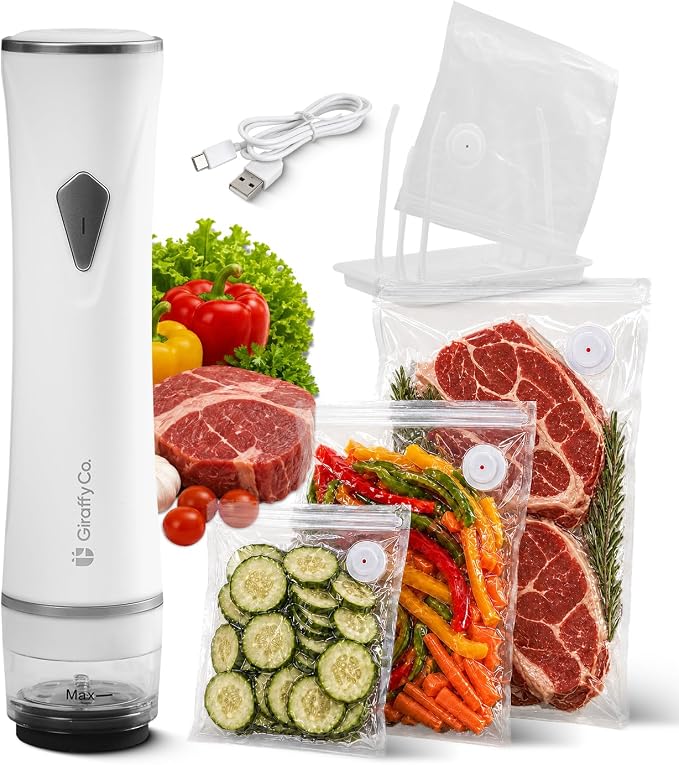
GIRAFFYCO documents a cordless set with 30 reusable valve bags, a charging cable and a foldable drying rack. The kit includes small, medium and large bags.
The attraction is having a named bag system to investigate alongside the pump. Compare the included sizes with your usual portions before buying more bags.
Worth comparing for: buyers who want to inspect a complete valve-bag starter set.
Check first: actual Australian bundle, bag dimensions, charging requirements and care directions.
Check GIRAFFYCO on AmazonSource: GIRAFFYCO set documentation. The documented kit must match the seller’s current offer.
60kPa electric handheld kit
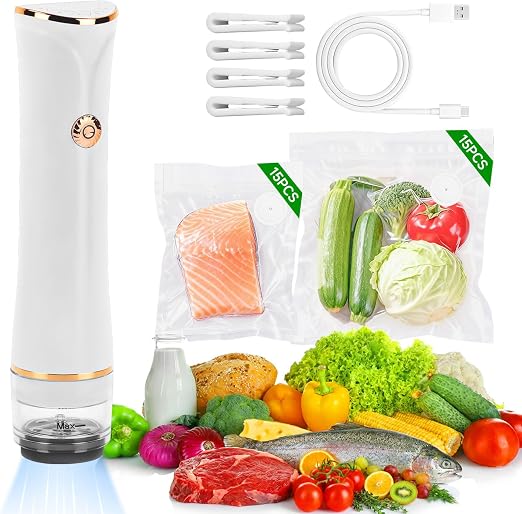
The supplied listing advertises an electric handheld vacuum sealer with a 60kPa vacuum level. The description does not establish the exact brand, battery arrangement or compatible valve system.
Inspect the kit if its current offer is competitive, but find the model and manual before comparing runtime, bag life or container support.
Worth comparing for: buyers prepared to verify the complete kit and supplies.
Check first: charging method, included bags, valve connection, cleaning and seller support.
Inspect the 60kPa handheld kitFeatures above come from the supplied listing description. No tested vacuum pressure, runtime or bag compatibility is claimed.
| Buying question | GIRAFFYCO set | 60kPa handheld listing |
|---|---|---|
| Are bags included? | 30 bags in the documented set; verify seller bundle | Confirm exact contents |
| Can I buy matching replacements? | Named GIRAFFYCO bag range to investigate | Identify the compatible bag system first |
| Is charging documented? | Documented rechargeable set; match required equipment | Confirm exact charging and power arrangement |
| Is comparative performance verified? | No hands-on SealHut test | No hands-on SealHut test |
Before you buy supplies
Check the bag system you want to use
This checklist directs you to the right documentation. It cannot physically test a valve, certify a bag or establish food safety. Select what you know, then investigate anything that remains unclear.
The supplies you will keep using
Bag size, valve design and replacement availability matter
Choose sizes for real portions
Measure what you normally put in a bag. A starter set with several sizes gives you options, but it can still contain bags you rarely use. Compare the usual portion with the clear packing area, keeping the zipper and valve zone available as directed.
A large pack count is not a useful measure of value on its own. Ten practical bags may suit a routine better than a mixed bundle with many inconvenient sizes. Once you know what works, compare replacement packs of equivalent size.
Confirm the valve connection
Look for the exact pump and bag compatibility guidance. Bags can look similar while using different valves or connectors. If an adaptor is needed, find out whether it is included and how it is fitted.
Apply the same check to containers. A container described as airtight is not automatically designed for vacuum use. Identify the compatible lid, valve and connection before ordering extra accessories.
Check replacements before the first purchase
Find the replacement bags in the sizes you expect to use and compare the delivered pack price. If those supplies are hard to identify, the kit is harder to evaluate as an ongoing purchase.
For the broader bag-material question, use our embossed and smooth bag guide. For portable power arrangements, use the portable sealer comparison.
The everyday routine
Reusable bags need a washing and drying plan
Before packing
Inspect the bag, zipper and valve. Choose the correct size and follow the instructions on clear areas around the opening and valve.
After opening
Check the permitted reuse and cleaning guidance for the exact bag and its previous contents. A reusable label is not an unlimited-use promise.
Before storing
Dry the bag and any removable parts as directed. Keep the supplies organised so the next packing job is straightforward.
Consider where washed bags will dry. A drying rack takes space, even when the pump itself is small. If you use several bags each day, that part of the routine may matter more than shaving a few centimetres off the pump.
Clean the pump and bags according to their own instructions. Do not assume the electrical unit can be immersed, that every bag is dishwasher-safe, or that every valve should be removed.
GIRAFFYCO’s bag range describes detachable valves and washing and complete drying before reuse. Apply those directions only to the exact compatible bags, not to a different kit with a similar appearance.
Inspect the supplies again before reuse. A damaged zipper, valve or bag surface can undermine the system. Follow the replacement guidance rather than continuing to use a bag simply because it once held a vacuum.
A useful purchase estimate
What could reusable bags cost over a year?
This calculator estimates physical bags required for an assumed number of uses. It then subtracts the usable starter bags already included in your kit and compares the replacement-bag purchase with a single-use bag cost.
The starting figures are editable examples. A reuse count is your planning assumption, not a tested bag life or a food-safety recommendation. Only reuse supplies when their instructions and condition permit it.
If the bag instructions or condition require fewer uses, change the input. The actual care requirements take priority over any favourable arithmetic.
When the bag loses vacuum
Check the simple parts of the system first
A bag that admits air does not automatically mean the pump is faulty. The opening, valve, material and connection all deserve inspection. Work through the exact troubleshooting directions instead of increasing suction or repeatedly pumping a damaged bag.
The zipper is not fully closed
Inspect the opening and follow the bag instructions for closing it. Check for food or residue in the closing area. Do not assume the pump will correct an incompletely closed zipper.
The valve or pump connection is unclear
Verify that the exact pump and valve are documented as compatible. Fit any required adaptor according to the instructions, and inspect the contact area.
The bag or valve is damaged
Look for damage as the supplier directs and replace the affected component or bag when required. Do not keep using damaged supplies simply to reach an assumed reuse count.
Know when to choose another system
A handheld pump does not replace every benchtop job
If you want to cut bags from rolls, create heat seams or pack larger repeated batches, compare a suitable external machine. If your routine centres on liquid-containing food, investigate the exact equipment and procedure before assuming a handheld kit can manage it.
The handheld purchase is more appealing when it solves an ordinary small job: convenient storage, a compatible bag you want to reopen, or a pump you can keep close to the supplies. Make that job specific before buying accessories.
Also consider whether your existing machine already supports the task through a documented accessory. Compare that option with buying a separate pump, rather than assuming you need another complete kit.
Compare handheld and benchtop systemsBefore ordering
Check the complete kit and the everyday costs
- Identify the exact pump.Find its model, operating method and manual. An electric handheld description alone does not establish charging or runtime.
- Match the valves and bags.Confirm the supported supplies and required adaptors. Check replacement sizes before purchase.
- Inspect the included bundle.Compare usable bag sizes, charging equipment and any drying accessories. A large count is not automatically useful value.
- Read the care instructions.Check which parts can be washed or removed and the limits on reuse. Plan where cleaned supplies will dry.
- Compare delivered Australian offers.Include replacement supplies and inspect current seller support and return details.
Buy for a routine you will actually follow
The pump is the small part of the decision. Bag compatibility, useful sizes, cleaning and replacement supplies determine whether the kit remains convenient after the first few uses.
Start with the documented GIRAFFYCO system or verify the generic kit in detail. If the bag method does not suit your usual packing job, choose another machine type before adding more supplies.
Vacuum packing does not sterilise food. Keep perishable food refrigerated at 5°C or colder and follow its storage instructions. For sous vide, use bags approved for the cooking conditions and a validated cooking method.
Read FSANZ food safety basics and the NSW Food Authority’s sous vide guidance.
More practical answers
Handheld vacuum sealer FAQs
Is a handheld vacuum sealer the same as a heat sealer?
A handheld vacuum pump removes air through a compatible valve. A heat sealer creates a seam across suitable bag material. A pump does not automatically seal the open end of an ordinary vacuum roll bag.
How many times can I reuse a vacuum bag?
Follow the instructions for the exact bag and its previous contents. There is no universal reuse count. Inspect the zipper, valve and material, and discard the bag when required. The calculator lets you enter an assumption; it does not establish a safe lifetime.
Can reusable valve bags be used for sous vide?
Use only bags explicitly specified for the intended cooking temperature, duration and method. Food-safe, reusable or freezer-safe labels alone do not establish sous vide suitability. Check the exact bag and valve directions.
Why does a valve bag refill with air?
Potential causes include an incompletely closed zipper, a dirty or damaged valve, a bag puncture or a mismatch between pump and valve. Check the exact instructions, inspect the components and stop using damaged supplies.
Does 60kPa guarantee better handheld performance?
An advertised vacuum-pressure figure does not establish seal retention, battery endurance, valve compatibility or cleaning convenience. Compare the complete kit and instructions rather than ranking products by that number alone.
Do handheld sealers work with vacuum containers?
Only use containers documented as compatible with the exact pump and connection. A container labelled airtight is not automatically designed for vacuum use. Confirm the lid, valve and adaptor requirements before buying.
Continue your research
Keep the pump and bag decisions together
How this guide was researched
We used the supplied handheld product links and images, checked GIRAFFYCO’s set and bag documentation, and distinguished the generic 60kPa listing from a verified named-model recommendation. We have not measured vacuum pressure, battery endurance or repeated-use seal retention.
The compatibility checker is a documentation checklist. The bag calculator uses an editable reuse assumption and a stated arithmetic method; it does not establish a safe bag lifetime or guarantee savings.
Sources
- GIRAFFYCO: set and included supplies
- GIRAFFYCO: compatible bags and care
- NESCO VS-09HH care/use guide: an example of a valve-bag handheld system; not instructions for the featured kits
- FSANZ: food safety basics
- NSW Food Authority: cooking sous vide
As an Amazon Associate, SealHut earns from qualifying purchases. Read our affiliate disclosure. Prices and availability can change; diagrams are explanatory, not test results.