
SealHut / VEVOR / DZ-260S-V3
VEVOR chamber vacuum sealer review: the 260mm model and its upkeep
The DZ-260S-V3 is an oil-pump chamber machine. Before choosing it for wet-food packing, compare your pouch size, working space and willingness to follow the pump-care routine.
Check VEVOR chamber sealer on AmazonOur assessment
An oil-pump chamber machine is an ownership choice
The VEVOR 260mm chamber vacuum sealer is worth investigating when you want a chamber workflow for suitable wet food and are comfortable maintaining the equipment. Its buying case depends on more than suction and price. The food pouch has to fit, the appliance needs a convenient station and the pump requires the specified oil care.
Our verdict
Shortlist the DZ-260S-V3 when its loading space suits your usual portions and oil-pump ownership fits your routine. Compare a dry-pump chamber machine when you want a different care arrangement, or an external sealer when ordinary occasional pouches are the main task.
The Amazon link you supplied identifies DZ-260S-V3. That matters because VEVOR sells several similarly named DZ-260 machines. A, S and C versions, and their regional suffixes, should not be treated as one model with interchangeable power ratings or chamber dimensions.
We have checked the current offer, the matching Australian manufacturer page and the A/S-series manual. This is a researched review rather than a tested performance verdict. We do not claim that a commercial-style body makes every household session faster or every finished pack more reliable.
Check the opening and the entire filled pouch in its permitted loading position.
Allow lid access, food handling and a practical way to clean the machine.
Understand initial oil preparation and ongoing checks before the first use.
Answers first
VEVOR chamber sealer questions
Which VEVOR model is this review about?
The supplied Amazon link identifies DZ-260S-V3. Keep it separate from DZ-260A, DZ-260C and differently rated regional versions.
Is 260W the vacuum pump rating?
No. The offer describes 260W sealing power. The series manual lists a 120W pump for the S-V3 column. Sealing and pump power are different specifications.
Does this model use pump oil?
Yes. The manual specifies an oil pump and prohibits starting the pump without oil. Follow the actual unit’s preparation and maintenance instructions.
What chamber dimensions are published?
The Australian manufacturer page and series manual list 330 × 270 × 50mm. Confirm usable loading clearance, lid shape and pouch placement rather than treating that rectangle as a complete maximum bag rating.
How wide is the sealing length?
The published sealing length is 260mm. The permitted bag mouth and loading position still need to follow the model instructions.
Is the V3 version rated for Australian mains?
The manual’s S-V3 column lists AC 230V, 50Hz, and the Amazon offer lists 230V. Confirm the delivered nameplate, suitable plug and exact revision before use.
Does the programmed cooling stage mean food chilling?
No. It is part of the machine’s sealing cycle. It does not cool the contents to a food-storage temperature or replace any additional recovery the appliance requires.
Can it handle liquids or marinated food?
The listing advertises those tasks, but the actual preparation, headspace and permitted procedures still govern use. A chamber-volume calculation is not an approved liquid fill amount.
Is it ready for nonstop commercial production?
Do not assume that from the listing title. Confirm duty limits, maintenance and support for the intended workload. This review does not test continuous throughput or certify business suitability.
Match the nameplate
Read the S-V3 column rather than a generic DZ-260 title
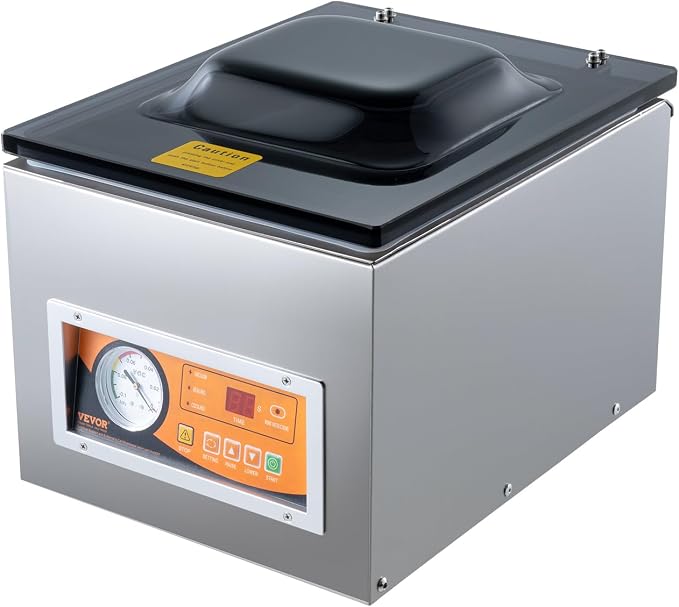
The table records published details, not our measurements. Check the actual revision if a dimension or power requirement determines whether you can use the appliance.
| Item | Published information |
|---|---|
| Model | DZ-260S-V3 on the supplied offer |
| Chamber dimensions | 330 × 270 × 50mm, published |
| Sealing length | 260mm, published |
| Power arrangement | Oil pump; S-V3 manual lists 230V / 50Hz |
| Pump power / rate | 120W / 4.2m³ per hour in the S-V3 manual column |
| Sealing power | 260W on the product page |
| Exterior dimensions | 405 × 316 × 320mm on the manufacturer page |
| Listed weight | 21.82kg on the manufacturer page |
The Amazon measurement field gives a slightly different weight, so treat this as a substantial machine of roughly this listed size rather than a precision lifting specification. Arrange storage and handling for the actual unit, with room to open the lid and work at the seal area.
Power numbers need the same care. Sealing power, pump power and a maximum appliance rating describe different things. Do not use one of those values as a measured energy consumption per pouch, or add selected marketing figures to create a new specification.
The main ownership difference
Understand oil preparation before buying
An oil pump introduces a care routine that many owners of small external sealers will not have encountered. The matching series manual explicitly prohibits starting the pump without oil. A bottle in the kit does not establish that the pump has already been filled or prepared for its first operation.
Use the actual instructions for the required oil, level, filling and draining procedure. Keep those directions available with the appliance. If the delivered unit or care information differs from the reference manual, resolve the discrepancy with support before operating it.
Maintenance should follow condition and manufacturer guidance, not a guessed calendar reminder. Keep a simple record of care performed, the approved supply used and any change noticed in operation. A planning calculator cannot measure oil condition or replace an inspection.
Think about practical access. You need a place where the specified checks can be made without repeatedly shifting a heavy appliance between crowded surfaces. Plan the permitted handling orientation and a suitable method for storing and disposing of care supplies.
This does not mean an oil-pump design is automatically a poor home choice. It means the choice should be deliberate. If you are comfortable keeping the routine and the machine solves a regular packing problem, the upkeep may be acceptable. If you want minimal pump-related tasks, compare a documented dry-pump option.
The packing space
A 260mm seal does not describe every part of the pouch
Start the size comparison with a normal filled package rather than a bare bag. Its opening must reach the seal area correctly, while the remainder of the pouch and contents must occupy the permitted loading space. A narrower opening does not guarantee a comfortable fit for a long or thick portion.
The published chamber dimensions do not, by themselves, define a complete maximum pouch size. The lid shape, bag pressing arrangement, seal assembly and required headroom all matter. Ask the seller for the approved loading dimensions if your purchase depends on a particular bulky item.
Do not confuse this chamber workflow with an external sealer’s ability to handle a long bag hanging in front. Confirm any external function explicitly before choosing it for that task. The supplied offer should not inherit features from a different chamber model simply because the housings look similar.
For meat and fish portions, also consider how easily you can keep the closing area flat and clean. Sharp edges, overfilling and residue are separate packaging concerns. A machine with a strong pump cannot compensate for a punctured pouch or an unsuitable material.
Controls and settings
Vacuum, sealing and cooling are separate stages
The series manual describes adjusting vacuum, sealing and cooling time. Those stages do different jobs. Vacuuming reduces pressure; sealing forms the closing seam; the programmed cooling stage belongs to that machine process. It is not a food-chilling programme.
Settings should come from the exact instructions, bag material and permitted task. The appropriate sealing time can depend on material thickness, and excessive heat is not an automatic improvement. Follow the guidance and inspect the result instead of treating a longer timer as a universal fix.
The pressure gauge can provide operating information, but a displayed value does not establish food safety or validate a finished package. Check the entire seam and pouch condition. Use documented troubleshooting and manufacturer support for a repeatable fault.
The listing uses broad home and commercial wording. Before choosing the appliance for a business workload, confirm its permitted duty, service access and support. We have not measured repeated-cycle performance and do not infer production capacity from that wording.
Tool one
Plan a session around the complete sequence
A vacuum timer is not the duration of a finished packing job. Allow time for the other programmed stages, opening and releasing as applicable, loading, inspecting and moving the pack. Use your observations and the actual instructions to enter a practical allowance.
Cycle-stage planning calculator
Starting values are editable arithmetic examples, not recommended settings or test measurements. Include any release and loading time in handling. Additional recovery, setup, food preparation and cleanup are excluded.
The example reserves twenty-three minutes and forty seconds for twenty identical entries. Changing a field shows which part of your plan carries the time. It does not establish that the machine can continuously repeat those entries or that the chosen settings suit the food.
For mixed portions, use separate calculations for the different tasks or reserve additional time. Keep food-handling and appliance-recovery requirements in the plan independently. A short calculated allowance should never dictate a rushed loading or care procedure.
Running costs
Compare ownership after the starter bags are gone
The listed kit includes starter bags and care items, but a repeat packing routine consumes more material than an initial kit supplies. Price the compatible bags you will actually use, then consider oil and other approved consumables separately.
A packet’s headline count can be misleading if some sizes do not suit your portions. Compare the delivered price with the usable count and material specification. Smooth chamber bags and textured bags are not a reason to assume all ordinary food-storage film is suitable.
Recurring supply-budget calculator
Enter your own prices and planned usage. Bag price zero means unspecified. Oil and other annual allowances are optional estimates you choose; the tool does not predict oil consumption or service frequency.
The result is a supply estimate, not a whole ownership cost or savings claim. It excludes purchase price, power use, labour, repairs and rounding to whole packets. A low entered total should not decide the purchase unless the packaging and maintenance requirements also fit.
For occasional use, reduce active weeks rather than assuming every calendar week includes a session. For frequent use, allow for retries and changed pouch sizes in your own quantities. Compare the same usable supplies across offers so the arithmetic describes a real choice.
Daily care and service
Keep cleanup and pump care in the same routine
After a session, follow the instructions for removing residue, cleaning the permitted surfaces and storing the appliance. Keep the closing area and gasket in good condition. Avoid copying the washability of a removable tray or seal bar from another brand into this model’s care procedure.
The manual includes service information for wear components, but that does not make every repair an owner task. Use its limits and qualified support for work outside the approved procedures. Ask about the availability of suitable replacement sealing materials and parts before buying for regular use.
Keep a useful care record
Record the model and revision, approved supply, date of care and any change in operation. That makes a recurring issue easier to describe.
Keep the right instructions
Store the actual manual with purchase details. Similar VEVOR names do not establish identical parts or pump requirements.
If vacuuming or sealing changes, check the documented causes before assigning a diagnosis. Poor bag placement, residue, damaged sealing components and pump-care issues are different possibilities. A higher timer value is not a substitute for resolving a fault.
Choose a clean, dry location with the access and clearance required by the actual instructions. The machine’s listed mass makes handling part of ownership. Plan the station so routine care can happen without forcing awkward repeated moves.
Liquids and cooking
A chamber method still needs food-specific preparation
The offer advertises wet food and liquids, but the permitted preparation and loading method remain essential. Keep the pouch opening clear and leave the required headroom. Confirm how the actual instructions handle rising liquid and interruption rather than using a chamber-volume calculation as a fill recommendation.
For meat or fish, select compatible food-contact material, protect it as directed from sharp edges and inspect the closing area. For liquids, follow the required cooling and handling method. The machine’s programmed cooling stage does not chill the contents for storage.
For sous vide, use material approved for the cooking conditions and a validated method appropriate to the food and its dimensions. Refer to NSW Food Authority guidance for the separate handling considerations. A sealed pouch does not verify pasteurisation.
Vacuum packing does not sterilise food or remove refrigeration requirements. Follow the contents’ storage and use instructions. We do not promise a new safe shelf life from the appearance of a pack or an advertised preservation multiplier.
The comparison that matters
VEVOR or a different packing routine?
Compare the Wevac V513 when a documented dry-pump chamber arrangement and removable care components interest you. Check its exact regional unit and usable pouch size. The models differ in more than brand and advertised seal length.
Compare our Anova Pro or FoodSaver VS4500 reviews when a simpler external pouch routine may already suit the job. For broader chamber options, use the Australian chamber sealer guide.
Final assessment
The DZ-260S-V3 belongs on a shortlist when you want its chamber workflow, your packages fit and oil-pump care is practical. Confirm the regional unit, kit, instructions and support before comparing delivered cost. Buy for that fit; we have not tested performance or durability.
Check VEVOR chamber sealer on AmazonResearch sources: the supplied Amazon Australia offer, matching VEVOR Australian model page and DZ-260A/S-series manual. Our assessment interprets documentation. The tools calculate entered time and supply allowances rather than tested speed, maintenance intervals or total ownership costs.
Qualifying purchases may earn SealHut a commission. Affiliate disclosure.