
SealHut · Small-kitchen buying review
FoodSaver Space-Saving Vacuum Sealer review
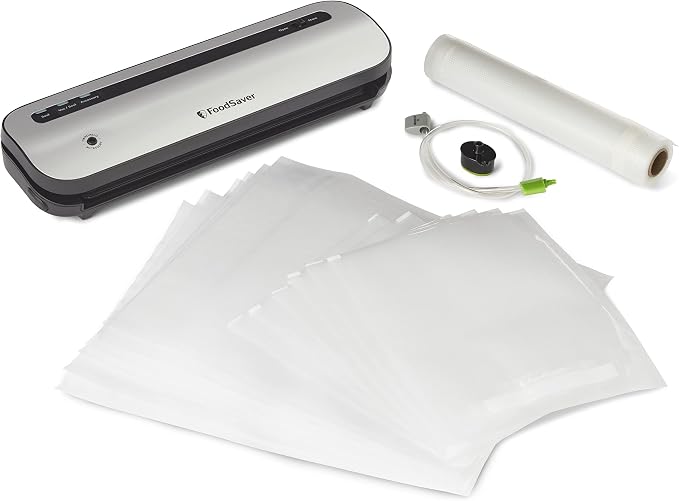
The silver bags-and-roll kit is worth comparing when the machine has to share a kitchen drawer. Start with the exact seller version, then check the space needed to store it and use it.
A researched buying review. We have not tested sealing performance, noise or long-term reliability. We may earn a commission from qualifying Amazon purchases.
Our assessment
A sensible shortlist option when storage comes first
A vacuum sealer is easier to use regularly when it has a practical home in the kitchen. If a bulky machine would live at the back of a cupboard, a slim design can be a more useful purchase even when both offer an ordinary packing routine. The value is in whether you can bring it out, work comfortably and put it away without reorganising the room.
Who should compare this kit?
Shortlist it for occasional home portioning when the storage footprint matters and you are comfortable preparing compatible bags. Compare a model with integrated bag preparation or additional control if those are the tasks you want to simplify.
Check the exact regional version and supported electrical supply first. An Australian Amazon destination alone does not establish that every seller’s unit is the local model.
That recommendation comes from the design and documented packing arrangement. It does not mean this unit has matched a larger machine in our tests. We have not measured its suction, cycle time or seam strength, so this review concentrates on fit with your routine.
Match the product before the features
This listing is not the Australian VS2298 review
The supplied Amazon short link resolves to a listing with ASIN B0BS1TJJJR and the title FoodSaver Space-Saving Vacuum Sealer with Bags and Roll, Silver. FoodSaver’s matching US product page identifies the VS1260 family and product number 2174660. Confirm the label and specifications of the actual seller’s unit rather than assuming every region uses the same version.
The supplied image filename contains VS2298. That filename is not the model evidence: FoodSaver Australia identifies VS2298 as Preserve, while its local Space Saving page identifies VS1298. The image itself shows a slim Space-Saving design, and we use it here under the product title you supplied.
This distinction matters because controls, included supplies, electrical specifications and support can differ. Do not transfer a local warranty, a cutter or a food programme from another FoodSaver model to this listing. Ask the seller for the exact model and regional documentation when a detail affects your purchase.
The manufacturer pages are useful for identifying the families: Australian Space Saving, Australian Preserve VS2298 and the matching US page in the sources below. Purchase buttons throughout this article retain your supplied Amazon affiliate link.
Quick answers
FoodSaver Space-Saving FAQs
Is this the FoodSaver VS2298?
The supplied title and resolved Amazon listing describe a Space-Saving kit. FoodSaver Australia names VS2298 Preserve. Confirm the seller’s exact model; the image filename alone does not identify it.
Is it cordless?
The matching manufacturer product describes a countertop system, not a separate cordless handheld. Confirm the actual seller unit’s power requirements and accessory arrangement.
Does a roll in the box mean built-in roll storage?
No. Included consumables and integrated machine features are different. Check the exact manual before assuming a storage compartment or cutter is present.
Will it fit in my drawer?
Measure the clear opening, internal width, depth and height. Use the actual unit’s dimensions in the checker and confirm practical access separately.
Can I assume the Australian warranty applies?
No. Verify the regional product, seller, purchase terms and available support. Do not transfer another model’s published guarantee to this offer.
Has SealHut tested this product?
No. This is a researched buying assessment using the supplied listing and manufacturer information, not a hands-on test.
Does the budget tool calculate savings?
No. It adds your entered machine, accessory and bag costs. It does not estimate reduced food waste, payback or product lifespan.
Can I use the bags for sous vide?
Check the exact bag’s approved cooking conditions and use a validated food method. A successful heat seam does not establish cooking suitability.
Should I choose this or a more fully featured machine?
Choose according to the repeated task. Prioritise storage for a simple routine, or compare bag preparation and extra controls when those would make a practical difference.
What the matching product page says
A compact system with a simple packing arrangement
FoodSaver’s VS1260 page documents push-to-lock operation and Seal Only, Accessory and Vac/Seal controls. It describes bag-alignment assistance, a removable dishwasher-safe drip tray and compatibility with suitable FoodSaver bags and accessories. Its listed starter kit includes a roll, two pre-cut bag sizes and accessory components. Check the seller’s actual box contents.
These details suggest a straightforward place to start for ordinary home portioning. They do not establish a delicate-food programme, a marinating routine or permission to pull free liquid into the machine. If a particular control is essential, look for it explicitly in the correct model’s manual.
We do not reproduce a percentage space-saving claim as a result for your kitchen. A reduction relative to one comparison machine does not tell you whether this one fits your drawer. The measurement tool below is more specific to the decision you are making.
Storage and use are different
The drawer test should come before the feature comparison
Measure the usable space rather than the outside of the cabinet. Drawer runners, a raised front edge, a hinge or items stored beside the machine can reduce the clear opening. A machine that fits the internal rectangle may still be difficult to get through that opening.
Allow for the way you will reach and lift it. A tightly packed drawer can make storage technically possible but inconvenient. The practical question is whether you can remove the appliance without moving several other objects or catching its cord on the surrounding contents.
The closed machine needs less consideration than the working setup. Before buying, put a representative filled pouch on the bench and imagine where the appliance, spare material and finished packs will sit. Keep access to the controls and whatever lid movement the manual requires.
If you plan to use a storage orientation different from the operating orientation, verify that the manufacturer permits it. The checker only considers a flat rectangle rotated on its base. It does not certify upright storage, stacking or a safe operating position.
Use actual measurements
Will the closed machine fit your storage rectangle?
Enter the dimensions of the seller’s exact unit and your clear internal space. Values begin at zero to prompt measurements; zero is treated as incomplete. Clearance is a total allowance per axis, not an amount added on every side. For example, entering 2cm on width leaves 2cm extra across that whole axis.
Passing this screen is a reason to investigate the fit further. Use a cardboard outline or the seller’s dimensional drawing to check the drawer opening and real access. Do not treat a green result as an instruction to operate the appliance inside a cupboard.
A roll is a supply, not a mechanism
Compare your bag-making routine honestly
The supplied kit gives you two ways to start thinking about packaging: ready-made pouches and material cut from a roll. Ready-made bags suit repeated portion sizes. A roll can accommodate changing lengths, but its width remains fixed. Which is more convenient depends on the portion you actually pack.
Do not assume that including a roll means the machine stores it internally or cuts it for you. Those features need confirmation for the exact model. If a cutter and storage compartment are important, compare our VS2198 review and the documented design of the seller’s alternative.
For a roll-based routine, include the time spent finding and preparing the material. If the appliance itself stores neatly but the rolls, cutting tool and accessories end up in several cupboards, the complete setup may still be inconvenient. Organise supplies around the place where you normally pack food.
The accessory route is also a separate purchase decision. Identify the actual vessel or zipper bag you want to use, its approved purpose and the required connector. An accessory port does not mean every valve system or every container you already own is compatible.
Make the ongoing cost visible
Estimate a first-year packaging budget
Enter the delivered machine price and the supplies you expect to buy. The planner adds a year of packaging to those upfront costs. It is useful for comparing a low-priced bundle with one that includes supplies you would otherwise purchase separately.
Use a replacement-bag cost for the usable size you need, including delivery. Enter zero if a cost does not apply. The starting machine and accessory prices are zero so no current product price is implied.
Keep the cost comparison like for like. A starter pouch that is unsuitable for your normal portion should not be counted as a usable pack. Nor should a roll be assigned a bag count without considering the cut length and sealing allowance required by its instructions.
What matters after purchase
Loading, cleaning and getting consistent packs
Follow the exact model’s loading instructions rather than copying another FoodSaver’s sequence. A bag opening needs to sit where that machine expects it. The latch, controls and indicator meanings can change between models, even when the overall appearance is familiar.
If a pack does not hold vacuum, inspect the whole pouch and consult the troubleshooting guidance. A wrinkle, contamination or damage can affect the result. Air returning does not, by itself, establish that the pump is faulty or that the product is unreliable.
For repeat problems, record the bag type, food condition and steps you used. Check whether the issue occurs with different compatible supplies. A clear description helps manufacturer support much more than a general statement that the machine does not work.
Cleaning needs its own time in the session. Follow the approved procedure for removing, washing, drying and replacing parts. Keep the electrical body dry as directed and stop using damaged equipment. The presence of a washable component does not make the entire appliance washable.
Storage is part of care as well as convenience. Review the correct latch position and permitted orientation in the actual manual. The fit checker cannot determine whether a particular storage arrangement is acceptable for the appliance.
Australian purchase checks
Regional suitability belongs in the buying decision
Ask the seller to confirm the model number, electrical rating, plug and regional support. Use the actual unit’s label and instructions. Do not rely on the country of the website, the colour of the machine or a similar-looking local product photograph.
Compare delivered prices after you know the offer is suitable. Include shipping and any required compatible supplies. Check the seller’s current return and support terms. We leave prices out of the article because marketplace offers, stock and bundles can change.
If your priority is local manufacturer documentation, compare the Australian Space Saving offer separately. Treat it as a separate model comparison rather than assuming the supplied Amazon listing is equivalent in every specification. That keeps the purchasing decision tied to the appliance you will receive.
Shortlist this kit
When a slim storage arrangement is useful and a straightforward external packing routine matches the job.
Compare another model
When integrated bag preparation, particular food controls or repeated liquid-containing packing is the main requirement.
Food handling comes first
Packaging does not create a new storage rule
Vacuum sealing does not sterilise food. Keep the food’s handling and refrigeration requirements separate from the decision about packing equipment. A sealed pouch is not a substitute for safe temperatures or a reason to extend a use-by date.
For cooking, check the exact bag’s approved conditions and follow a validated method appropriate to the food. A bag that can form a seam is not automatically suitable for every sous vide temperature and duration. The sealer prepares packaging; it does not cook or certify the process.
Use our sous vide guide, the NSW Food Authority guidance and food-specific instructions. There is no universal refrigerated shelf-life table in this review.
The final decision
Buy for the space and routine you actually have
This Space-Saving kit is worth comparing when a larger machine would be awkward to store and you mainly want an ordinary home portioning system. The slim design has a clear purpose. The remaining decision is whether the exact seller version, supplies and support make it a practical purchase for your kitchen.
Start with the regional check, measure the storage and working setup, then compare replacement material costs. If the routine still looks convenient, use the current Amazon offer to decide whether the delivered price makes sense. That is a stronger basis for purchase than a general freshness claim or a large customer-review count.
Check the Space-Saving model on AmazonResearch sources: FoodSaver’s matching VS1260 / 2174660 product page and the Australian model pages linked above. Buying assessments are our interpretation of the documented design. We have not measured performance or durability. The calculators use your entries and do not validate a physical fit, regional electrical suitability or food process.
The supplied image URL is preserved exactly despite its filename. Qualifying Amazon purchases may earn SealHut a commission. Read our affiliate disclosure.